The Ultimate Guide to Toggle Switch Types: SPST, DPDT, and Momentary Explained
- January 16, 2026
- 1,175
- DAIER Technical Team
In the world of electromechanical components, few devices are as iconic and universally used as the toggle switch. From the dashboard of a classic aircraft to the control panel of heavy industrial machinery, the satisfying “click” of a toggle switch represents control.
For engineers, procurement managers, and OEM designers, however, “toggle switch” is just a category. The real challenge lies in selecting the exact configuration. What is the difference between SPST and SPDT? Do you need a latching or a momentary action? Why does a DPDT switch have six pins?
In this comprehensive guide (Chapter 1 of our Toggle Switch Engineering Series), we will deconstruct every type of toggle switch, explain their circuit logic, and help you specify the perfect component for your next project.
What is a Toggle Switch?
A toggle switch is a type of electrical switch that is actuated by a mechanical lever, handle, or “bat” to open or close an electrical circuit. They are characterized by their distinct physical operation: a lever is pushed back and forth to switch the device on or off.
Unlike push buttons (which compress) or rocker switches (which pivot flatly), toggle switches offer a distinct tactile feedback and visual indication of the switch’s status. They are renowned for their durability, ease of operation with gloves, and high current handling capabilities, making them the preferred choice for:
- Industrial Control Panels
- Automotive & Marine Modifications (12V/24V systems)
- Aviation & Aerospace
- Medical Instrumentation
Understanding “Poles” and “Throws”: The Core Logic
When browsing a catalog from Daier or any major supplier, you will encounter acronyms like SPST, SPDT, or DPDT. These refer to the internal circuitry of the switch.
To choose the right switch, you must answer two questions:
1. Poles (P): How many separate circuits do you want to control at once?
2. Throws (T): How many “ON” positions can the switch connect to?
Let’s break down the four most common configurations.
1. What is an SPST Switch? (Single Pole, Single Throw)
The “Basic On-Off” Switch
- Pins: 2 terminals
- Function: ON-OFF
The SPST (Single Pole Single Throw) is the simplest form of a toggle switch. It controls a single circuit and has only one “ON” position.
- How it works: When the toggle is up, the circuit is closed (Current flows). When down, the circuit is open (Current stops).
- Best For: Simple applications like turning on a fog light, a cooling fan, or a machine’s main power.

Caption: An SPST switch simply connects or disconnects two terminals.
2. What is an SPDT Switch? (Single Pole, Double Throw)
The “Select or Changeover” Switch
- Pins: 3 terminals
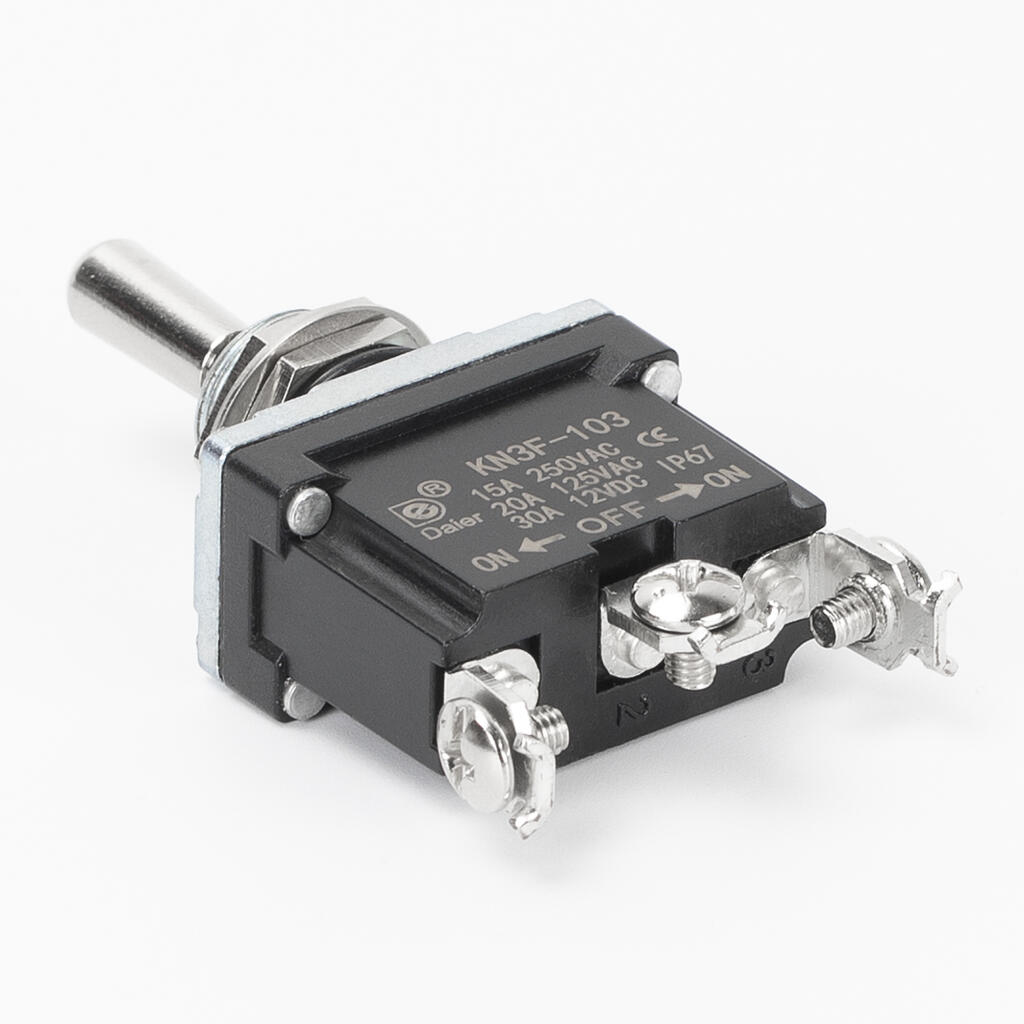
- Function: ON-ON or ON-OFF-ON
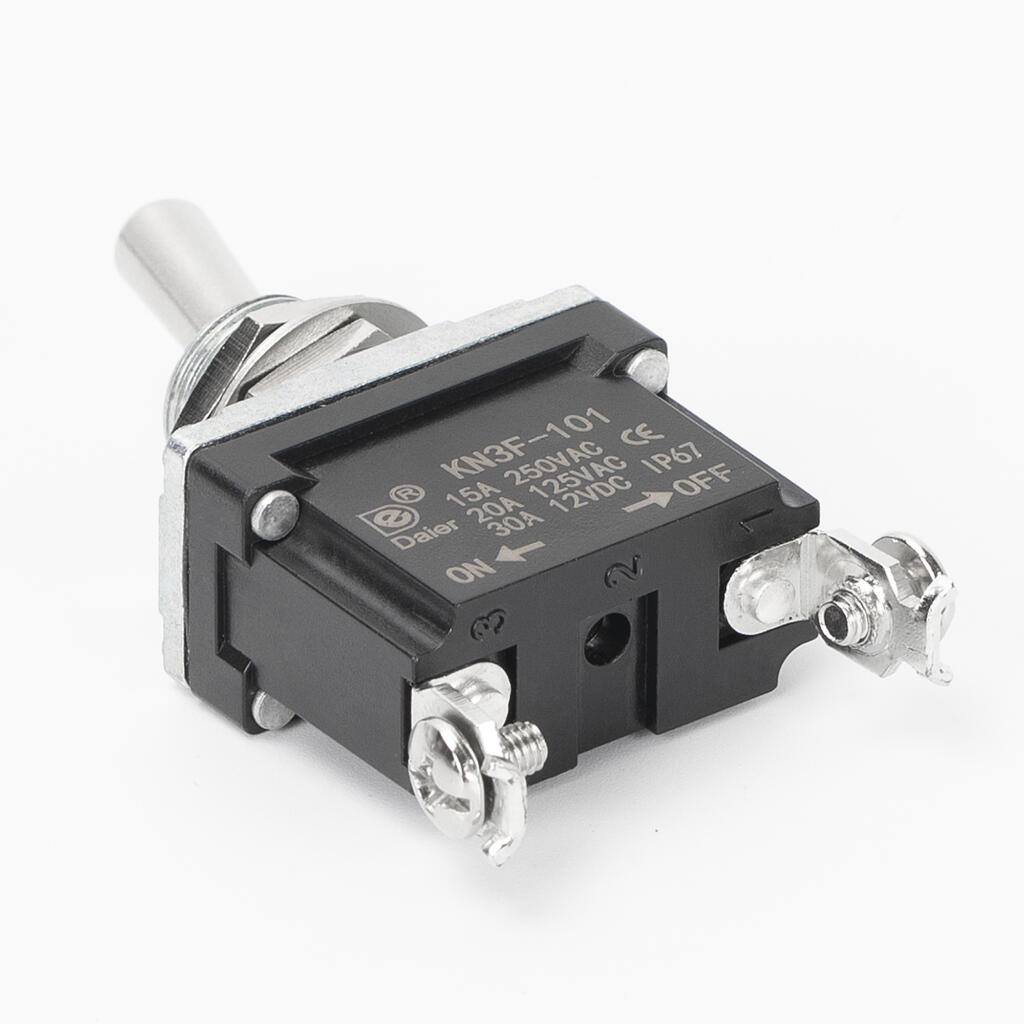
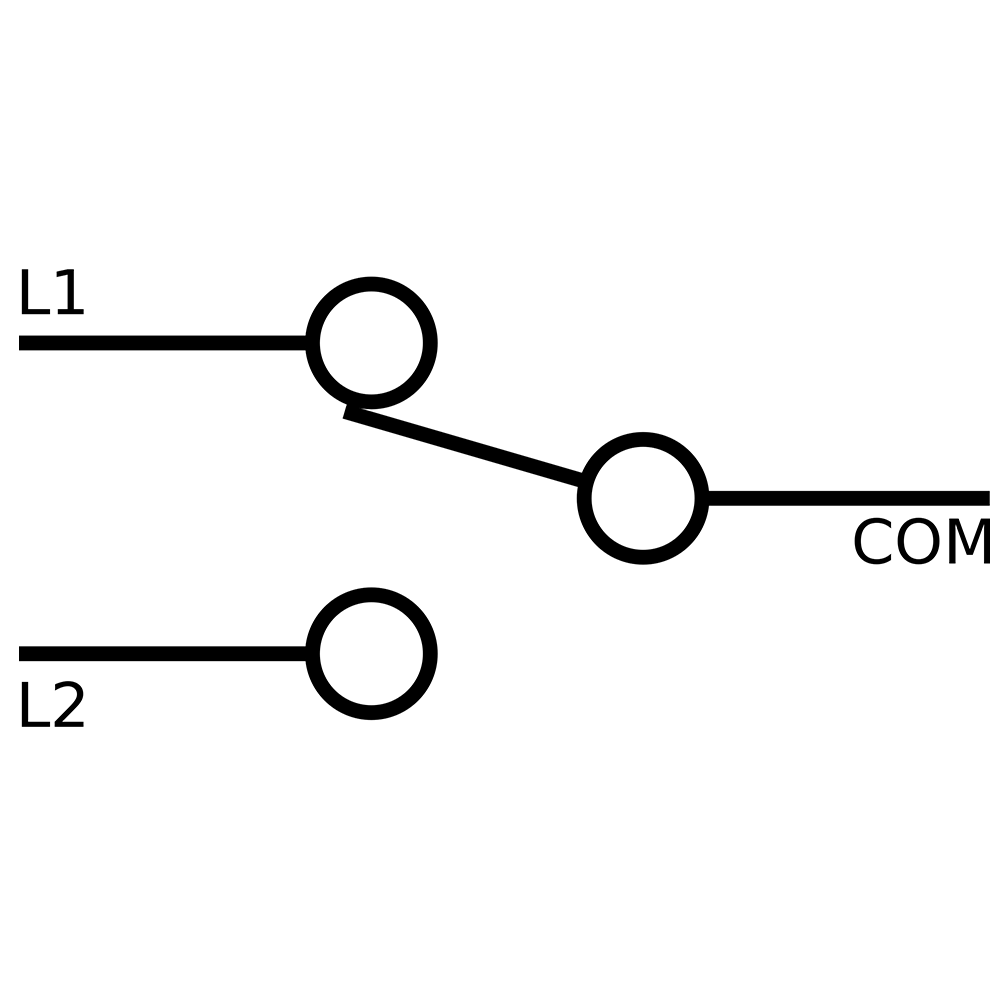
An SPDT (Single Pole Double Throw) switch has one input (Common) and two potential outputs. It allows you to route power to two different loads, but not at the same time.
- How it works:
▷ Position 1: Connects Common Pin to Output A.
▷ Position 2: Connects Common Pin to Output B.
- Best For:
▷ Switching between two power sources (e.g., Battery 1 vs. Battery 2).
▷ Switching a device between two modes (e.g., High Speed vs. Low Speed).
▷ Can also be used as a standard SPST switch by simply leaving one output pin unconnected.
3. What is a DPST Switch? (Double Pole, Single Throw)
The “Two-in-One” Switch
- Pins: 4 terminals
- Function: ON-OFF
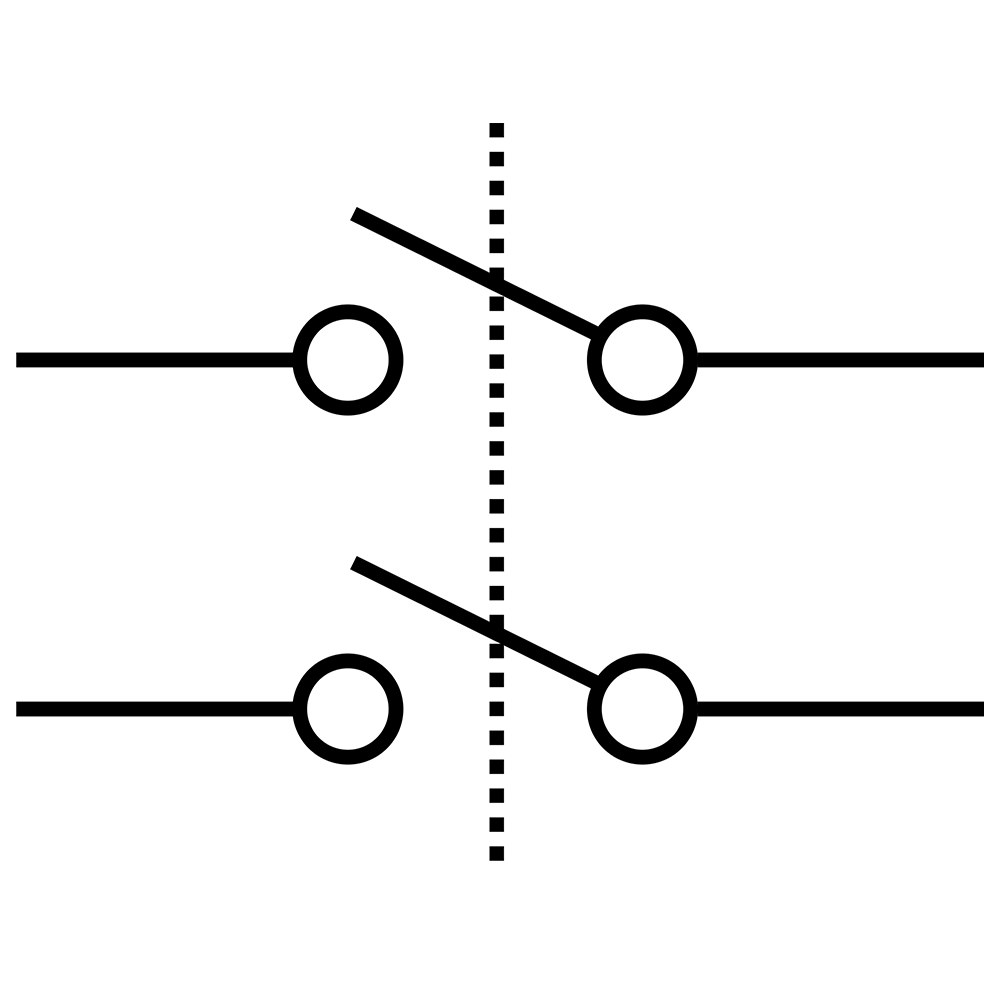
Think of a DPST (Double Pole Single Throw) switch as two SPST switches controlled by a single plastic lever. It controls two completely independent circuits simultaneously.
- How it works: Flipping the switch turns both Circuit A and Circuit B on or off at the exact same time.
- Best For: Cutting both the Live and Neutral wires in a 220V appliance for safety, or turning on a light and a fan simultaneously.
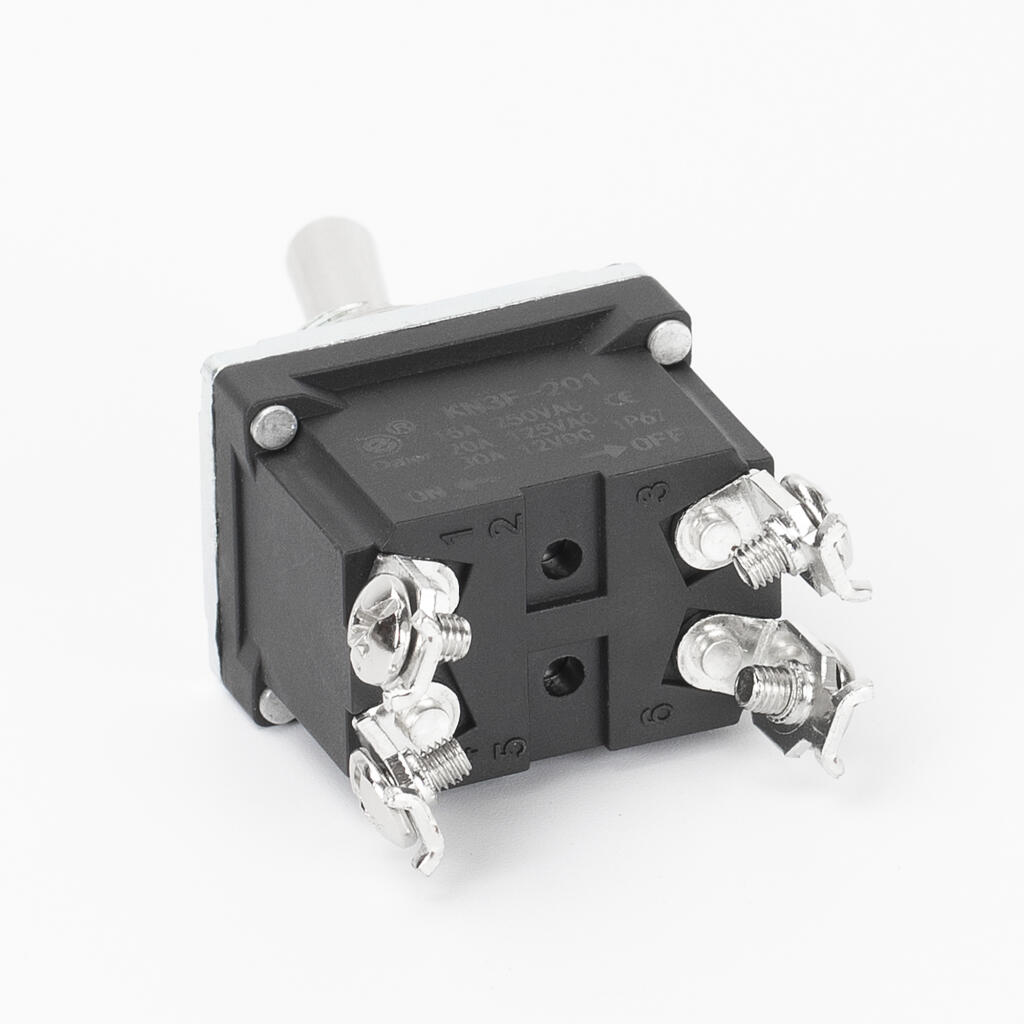
4. What is a DPDT Switch? (Double Pole, Double Throw)
The “Reverse Polarity” Master
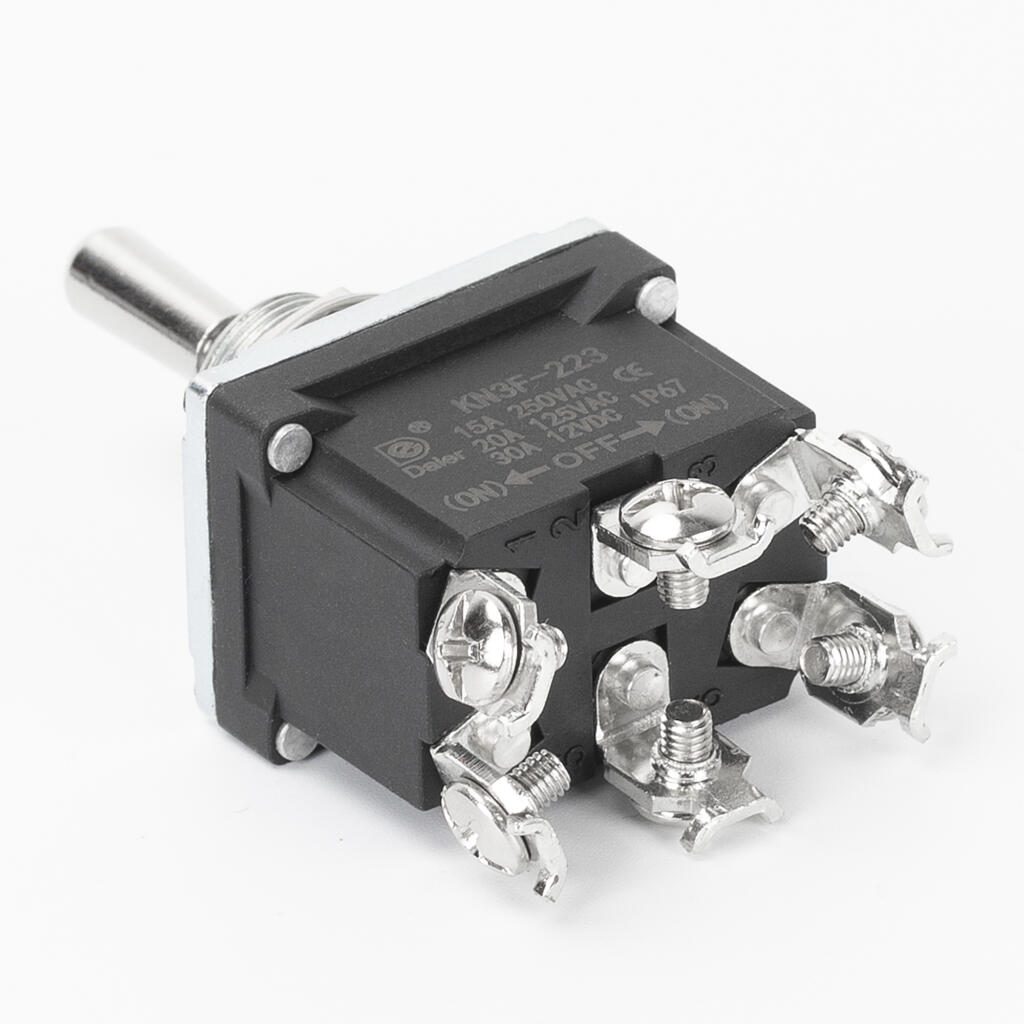
- Pins: 6 terminals
- Function: ON-ON or ON-OFF-ON
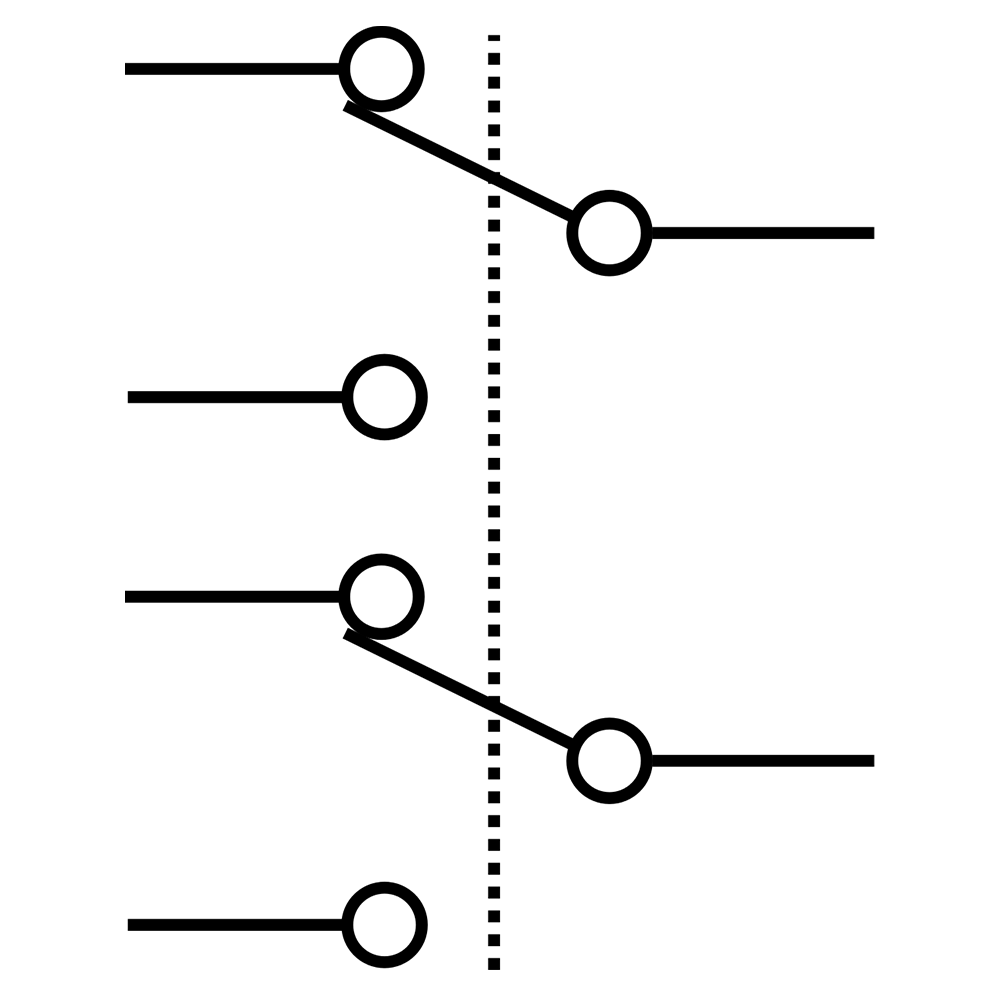
The DPDT (Double Pole Double Throw) is the powerhouse of industrial switching. It essentially consists of two SPDT switches mechanically linked together.
- The Killer Application: Motor Reversing. By wiring a DPDT switch in a specific “crossover” pattern, you can reverse the polarity of a DC motor. This is how you control a power window going up/down or a winch reeling in/out.
- Best For: DC Motor reversing, complex signal routing, stereo audio switching.
Momentary vs. Latching: Which Action Do You Need?
Once you know the poles and throws, you must decide how the handle behaves. This is the difference between “Toggle” and “Trigger.”
What is a Maintained (Latching) Switch?
A maintained switch (often called Latching) stays in the position you place it.
- Action: You flip it ON, and it stays ON until you flip it back.
- Common Functions: ON-OFF, ON-ON.
- Use Case: Headlights, bilge pumps, conveyor belts. Most standard switches are latching.
What is a Momentary Switch?
A Momentary switch is spring-loaded. It only remains in the active position while you are physically holding it. The moment you let go, it snaps back to a default position.
- Notation: In datasheets, parentheses () indicate momentary action.
▷ ON-OFF: Latching.
▷ (ON)-OFF: Momentary ON, snaps back to OFF.
▷ (ON)-OFF-(ON): Momentary on both sides, center OFF.
- Use Case:
▷ Car Horn: You only want it to sound while pressing.
▷ Engine Starter: You stop cranking once the engine fires.
▷ Hydraulic Lift: The lift stops moving when you release the lever.
2-Position vs. 3-Position Logic
Depending on the internal mechanism, toggle switches usually come in two mechanical variations.
2-Position Toggle Switches
The handle stops at two distinct angles.
- Function: ON-OFF or ON-ON.
- Application: Simple binary choices. Power is either On or Off; Input is either A or B.
3-Position Toggle Switches
The handle has a center position (usually neutral/off) and two side positions.
- Function: ON-OFF-ON.
- The Centre-Off Advantage: This is crucial for motor control (Forward – Stop – Reverse). Without the center-off position, you would instantly snap the motor from full forward to full reverse, which would damage the equipment.
Terminal Types: Standard vs. PCB Mounting
Depending on your assembly requirements, Daier offers two distinct categories of terminal configurations.
1. Standard Terminals (For Panel Mounting & Soldering)
For heavy-duty applications (like our KN3C series) or manual wiring, we offer the robust terminals shown in Diagram A:
- Screw ( ): Standard for industrial wiring.
- Press Plate (T): Best for securing stranded wires.
- Hitch/Quick Connect (R): For fast assembly lines.
- Solder Lug (S): For permanent connections.
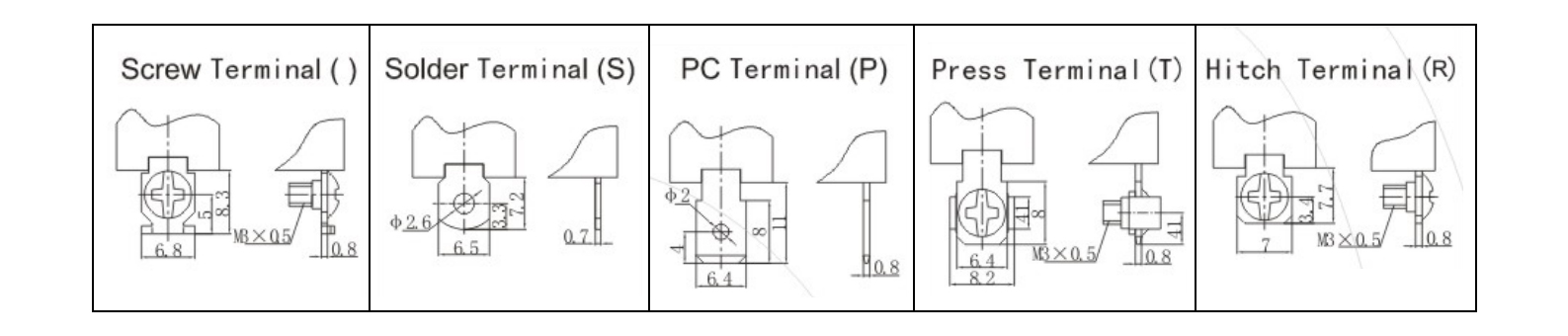 Figure A: Standard terminals for Medium Toggle Switches.
2. PCB Terminals (For Miniature MTS/SMTS Series)
For electronics requiring direct mounting onto a Printed Circuit Board, orientation is key. As shown in Diagram B, we provide specialized angled terminals to fit tight enclosures:
- PC Pin (2): Straight pins for standard vertical mounting.
- Right Angle Horizontal (3/3H): The switch lies flat on the PCB (90-degree bend). This is crucial for low-profile devices where height is limited.
- Right Angle Vertical (4/4H): The switch stands upright, but the pins connect sideways.
- Long Solder (5): Extended length for wire-wrapping or thick multilayer boards.
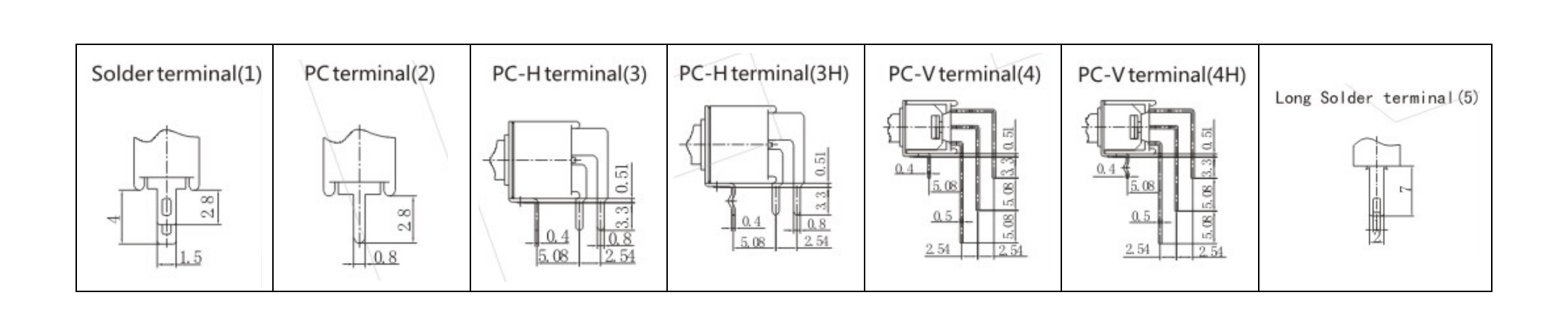 Figure B: Specialized PCB terminals for Miniature Series.
Heavy Duty vs. Miniature: Size Matters
Toggle switches are not “one size fits all.” At Daier, we categorize our lineup into three distinct series based on physical size and power handling capabilities. Choosing the right one ensures you don’t burn out a switch or waste valuable panel space.
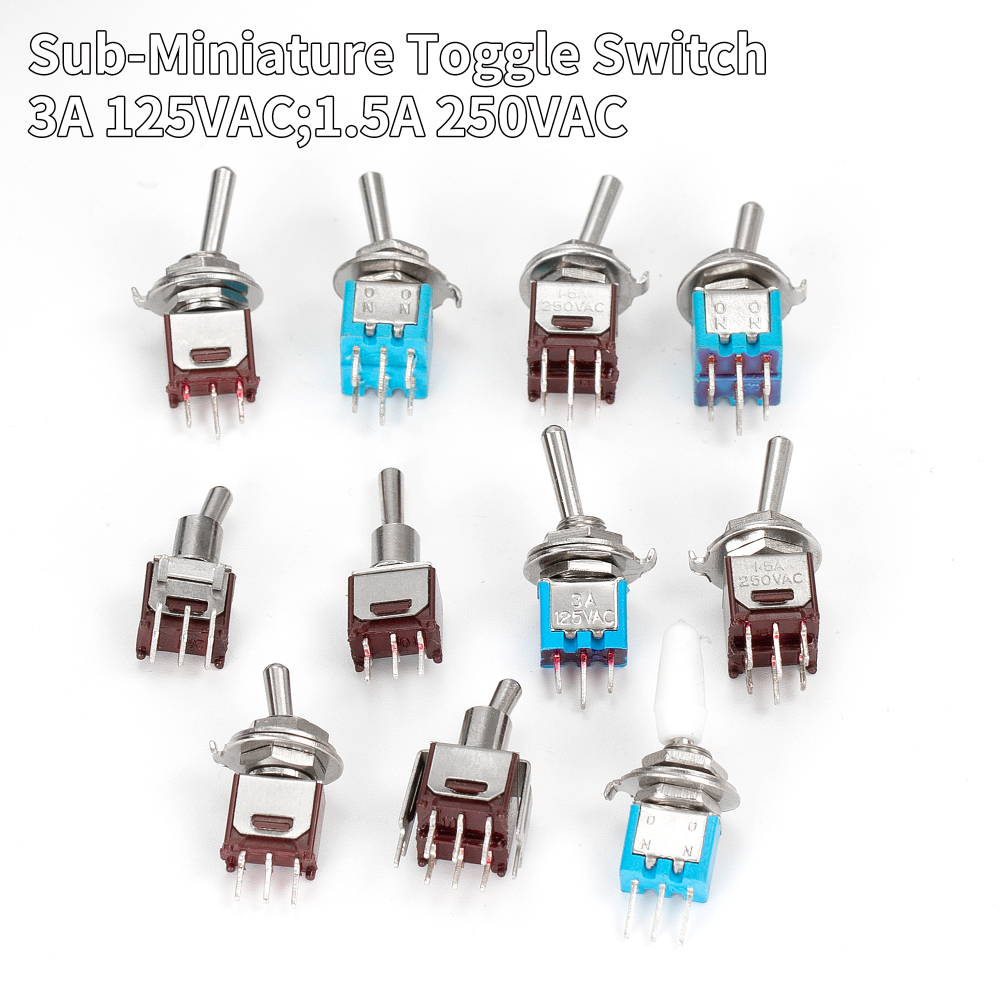
1. Sub-Mini Toggle Switches (SMTS Series): Small but Mighty
The smallest of the bunch. Distinguished by their blue body and ultra-compact footprint, these are the go-to choice when every millimeter counts inside a handheld device or tight enclosure.
- Mounting Hole: Ultra-small (typically fits 5mm holes or PCB mounting).
- Rating: Up to 3A 125VAC.
- Best For: Precision instrumentation, handheld gadgets, and direct PCB mounting where space efficiency reigns supreme.
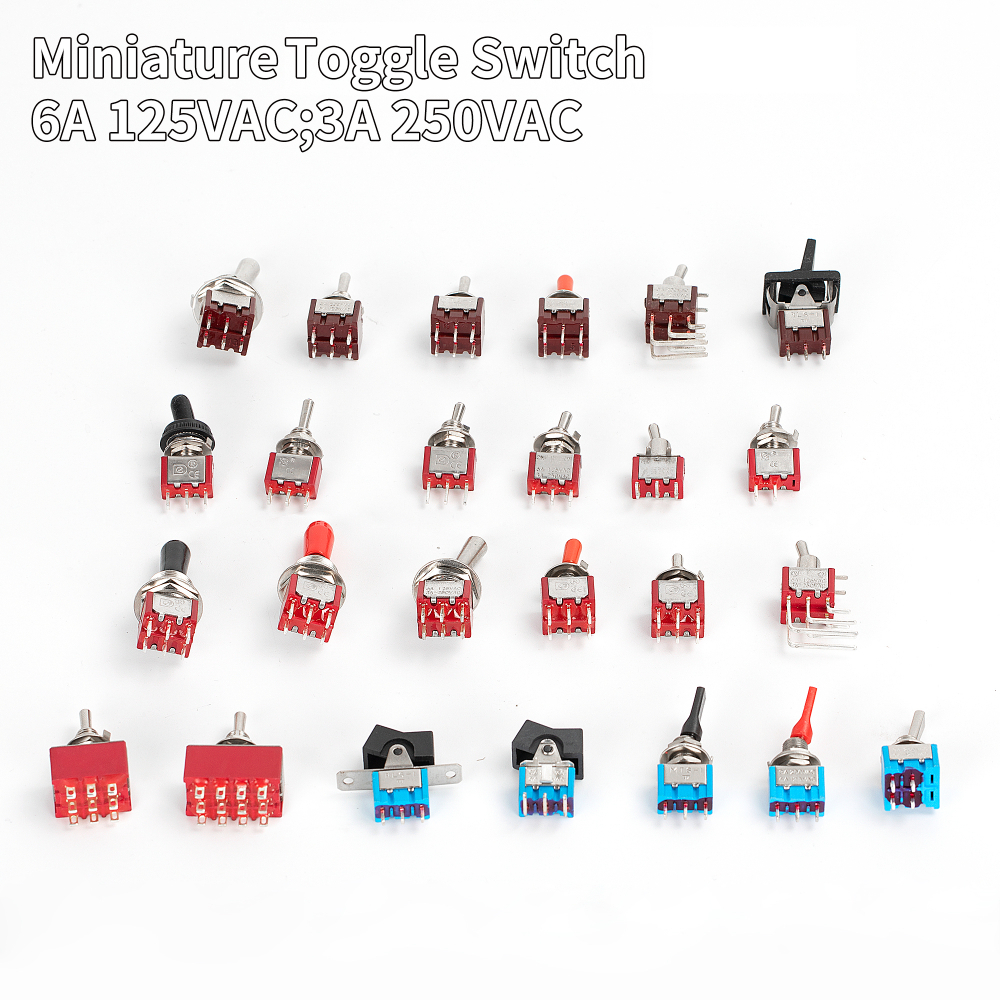
2. Miniature Toggle Switches (MTS Series): The Versatile Middle Ground
Striking a balance between size and power, the “Red Body” MTS series is the industry standard for consumer electronics. They typically feature a 6mm (1/4 inch) mounting bushing.
- Mounting Hole: 6mm (1/4 inch).
- Rating: Higher than the sub-mini, offering 6A 125VAC / 3A 250VAC.
- Best For: Household appliances, audio equipment, and control panels where you need moderate power in a compact form factor.
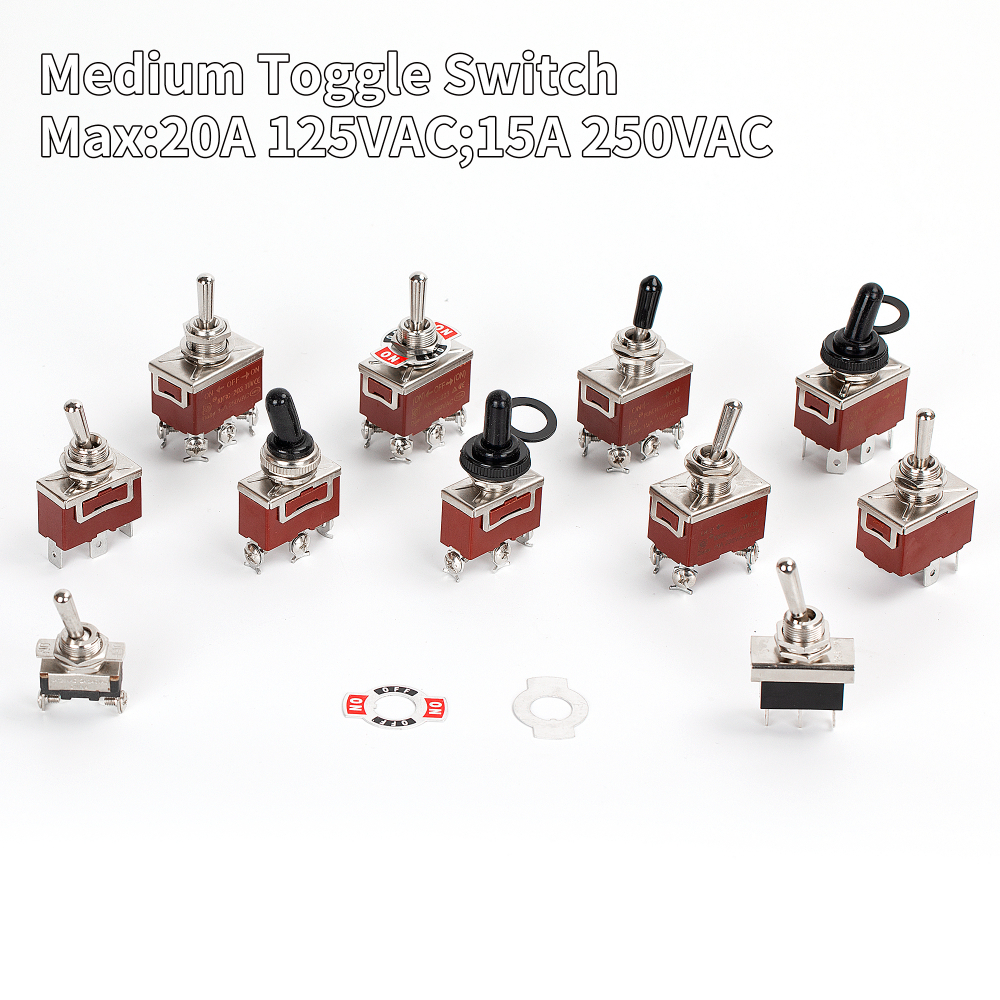
3. Medium Toggle Switches (KN3 Series): Power and Presence
When your project demands a switch with heft, the Medium series takes the stage. Often referred to as “Standard” or “Heavy Duty” in the industry, these robust components feature a 12mm (1/2 inch) mounting hole and screw terminals for easy industrial wiring.
-
Mounting Hole: 12mm (1/2 inch).
-
Rating: Industrial grade, handling 10A, 15A, up to 20A at 125VAC.
-
Best For: Heavy industrial machinery, automotive dashboards, marine panels, and any high-current application requiring reliable performance.
Beyond the Circuit: Actuators & Accessories
While the internal rating is critical, the external interface—how the switch feels and looks—is what your customers actually touch. Daier offers a modular approach to switch design, allowing you to customize the “user experience” of your control panel.
1. Actuator Styles (Handles):
Standard metal bats are classic, but not always practical. We offer:
- Flat Levers: For a modern, high-end dashboard look.
- Plastic/Color Caps: For color-coding functions (e.g., Red for Stop, Green for Go).
- Long/Short Bats: To fit specific clearance requirements.
2. Safety Guard Covers:
For mission-critical applications like racing ignitions or industrial emergency stops, accidental actuation is not an option. Our “Missile Style” Safety Covers (as shown above) ensure the switch stays OFF until you deliberately flip the cover open.
Summary: How to Read a Toggle Switch Specification
To wrap up Chapter 1, here is a checklist for selecting the right Daier switch for your project. When contacting our sales team or browsing our catalog, define these parameters:
1. Poles/Throws: Do you need 2 pins (SPST), 3 pins (SPDT), or 6 pins (DPDT)?
2. Action: Do you need it to stay put (Latching) or spring back (Momentary)?
3. Positions: 2-Position (On-Off) or 3-Position (On-Off-On)?
4. Terminals: Screw, Solder, or Spade?
5. Rating: What is the voltage and amperage of your load? (e.g., 12V 20A).
What’s Next?
Now that you understand the types of switches, the next challenge is connecting them correctly. A simple mistake in wiring a DPDT switch can lead to a short circuit.
👉 Read Chapter 2: Mastering Toggle Switch Wiring – Diagrams for 12V, Motors, and Lights (Coming Soon)
For Distributors & OEMs: Packaging That Fits Your Brand
Daier Electron isn’t just a component manufacturer; we are your supply chain partner. We understand that for B2B distributors, product presentation is key.
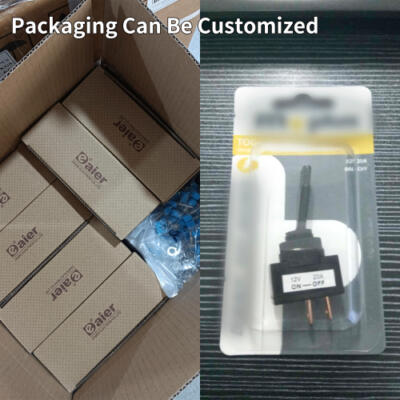
Unlike generic market stock, we offer fully customizable packaging solutions:
- Private Labeling: Your logo and part numbers printed directly on the box.
- Retail-Ready Blister Packs: Perfect for auto parts stores and marine supply shops.
- Bulk Industrial Trays: Optimized for automated assembly lines to reduce unpacking time.
Ready to Build Your Perfect Switch Solution?
From selecting the right waterproof rating to designing custom retail packaging, Daier Electron is your end-to-end partner. Whether you need a specific 12V modification or a complete bulk order strategy, our engineers are ready to assist.
