
Rotary Selection for Electronic & Industrial Controls
Rotary Switches
DAIER supplies rotary selector and cam changeover switches for audio equipment, electronic assemblies and industrial controls. The range includes different pole and position configurations, PCB and wired connections, and shaft options to suit the assembly.
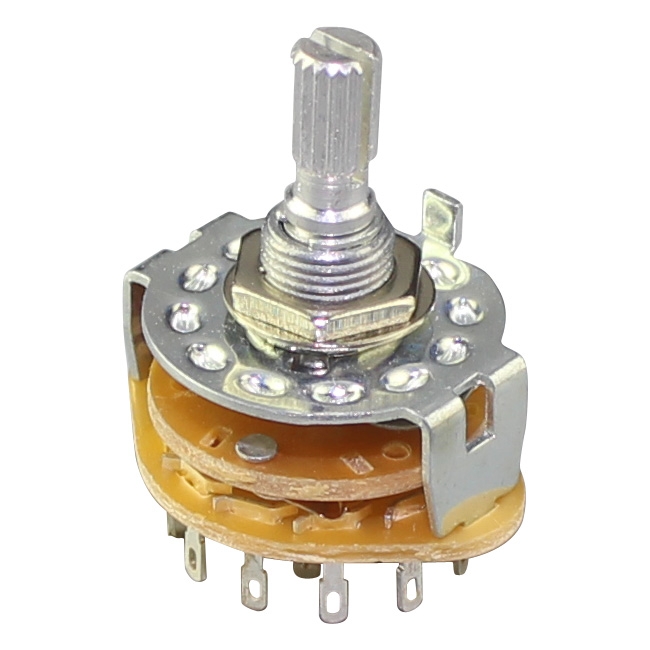
- Product Range Selector & Cam Changeover
- Circuit Options Multiple Poles & Positions
- Connection Options PCB, Solder & Screw
- Shaft Options Multiple Lengths & Profiles
Rotary Switch Models
LW26-63/3 3 Position Cam Rotary Changeover Switch
The rotary changeover switch is a 3-position 12 terminal cam switch with a latching ON/OFF/ON (1-0-2) design. Ui: 690V, Ue: 440V AC, Ith: 63A.
RBS-1 Rotary Switch Selector
RBS-1 rotary switch selector can be made with PCB terminal or solder terminal.
RTS-01 Band Selector Rotary Switch
The band selector rotary switch can be made with different poles.
RS16 Rotary Selector Switch
RS16 rotary selector switch is most popular used in audio equipment.
RT2
RT2 rotating switches are MIL qualified to exacting electrical
Selection Guide
Choosing a Rotary Switch
The range includes compact selectors and cam changeover switches for different control tasks. Compare the circuit diagram and electrical specification for the chosen construction, together with these three items.
Poles & Positions
Poles determine how many circuits the switch controls. Positions determine the available selections. Choose the required combination and contact sequence rather than treating the highest position count as available with every pole count.
Terminals & Wiring
PCB terminals connect to a circuit board; solder terminals suit wired assemblies. The cam changeover switch uses screw connections. Compare the terminal diagram, pin spacing and wiring access for the required construction.
Shaft & Mounting
Selector versions offer different shaft lengths and profiles, including flat, round and toothed options. Match the shaft to the knob and check the mounting drawing, panel thickness and space behind the panel.
Applications
Typical Switch Applications
Rotary selection for electronic assemblies and equipment control panels.
Audio & Signal Selection
Select signal paths or settings in audio equipment, using the required poles and positions.
Industrial Control Panels
Provide defined switching sequences for equipment controls with rotary and cam constructions.
OEM & Replacement Assemblies
Match the contact sequence, terminals, shaft and mounting dimensions to a new assembly or existing part.
Common Questions
Rotary Switch FAQs
Answers about circuit selection, connections, shaft fit and ordering.
A pole is an independently switched circuit. A position is a selectable setting. The available combinations vary by construction; more poles can mean fewer positions. Specify both and check the contact diagram.
The selector range includes PCB and solder-terminal versions, while the cam changeover switch uses screw connections. Availability depends on the product construction. Compare pin spacing, terminal direction and the wiring diagram.
Include the shaft length and profile, knob fit and panel requirements. The selector range lists flat, round and toothed shafts, with available lengths varying by product. Use the drawing to confirm the fit.
Compact selectors serve signal and setting selection in electronic or audio equipment. Cam changeover switches use a defined contact sequence for equipment control circuits. Match the construction, connection diagram and stated load rating to the application.
Send the model code or required poles and positions, terminal format, shaft and mounting requirements, and quantity. For a new control assembly, include the circuit diagram and operating load. A reference photo or drawing helps with replacement enquiries.
Discuss Your Rotary Switch Requirements
Send the model code or required poles and positions, terminal format, shaft dimensions and quantity. For a new assembly, include the circuit diagram, operating load and mounting drawing so we can review the required version.
Prefer email? sales1@chinadaier.com