Cable Gland Size Chart: PG vs Metric (M) Sizes
- November 18, 2026
- 15
- DAIER Technical Team
A cable gland size chart helps you check two fits before you order. The first is between the gland and the enclosure. The second is between the gland seal and the outside of the cable jacket. Both have to work. A PG13.5 gland and an M20 gland can each take a 10 mm cable in the right model, but they fit different tapped openings. Start with the cable jacket diameter and the enclosure entry you have, then use the drawing for the chosen gland to confirm the mounting dimensions.
If you are replacing a gland, bring the old part or the enclosure drawing to the bench. If you are designing a new panel, record the cable’s diameter and tolerance before you lay out the holes. Those details will narrow the choice much faster than a part number on its own.
1. How Cable Gland Sizes Are Defined
The size on the body identifies the entry thread. PG7, for example, has a nominal thread outside diameter of 12.5 mm. M20 × 1.5 has a nominal diameter of 20 mm and a pitch of 1.5 mm. The gland’s clamping range is a separate specification. It tells you which jacket diameters the seal and clamping mechanism are designed to accommodate.
The difference becomes clear when you fit a gland to a panel. The body can screw into the enclosure cleanly even if the cable is too small for the seal. The reverse happens too: the cable fits the seal, but the gland body has the wrong thread for the box. Check both specifications before you compare materials, prices, or IP ratings.
2. PG and Metric Threads at a Glance
PG stands for Panzergewinde, the conduit thread system defined in DIN 40430. PG uses an 80° thread profile, and the pitch varies by size (1.27 mm to 1.59 mm). The EN 60423 metric cable gland sizes shown in this guide use a 60° thread profile and a 1.5 mm pitch. PG and metric tapped entries require their own matching threads, even when the outside diameters are close.
| Property | PG Thread | Metric Thread |
|---|---|---|
| Standard | DIN 40430 | EN 60423 / ISO 68-1 |
| How the Size Is Marked | PG designation, such as PG13.5 | Nominal diameter and pitch, such as M20 × 1.5 |
| Thread Angle & Pitch | 80° profile; 1.27–1.59 mm pitch | 60° profile; 1.5 mm pitch (M12–M63) |
| Where You May Encounter It | Industrial enclosures, replacement panels, and PG-tapped equipment | New panel designs and IEC metric-threaded equipment |
3. PG Cable Gland Size Chart from PG7 to PG48
The thread dimensions below identify standard DIN 40430 PG sizes (molded nylon threads typically caliper 0.1–0.2 mm below nominal OD for smooth engagement). Cable clamping ranges depend on the gland’s internal rubber seal insert, so always confirm the exact clamping range on the selected model’s datasheet before ordering.
| PG Thread | Nominal Thread OD (mm) | Approx. Pitch (mm) | Typical Cable OD (mm) |
|---|---|---|---|
| PG7 | 12.5 | 1.27 | 3.0–6.5 |
| PG9 | 15.2 | 1.41 | 4.0–8.0 |
| PG11 | 18.6 | 1.41 | 5.0–10.0 |
| PG13.5 | 20.4 | 1.41 | 6.0–12.0 |
| PG16 | 22.5 | 1.41 | 10.0–14.0 |
| PG21 | 28.3 | 1.59 | 12.0–18.0 |
| PG29 | 37.0 | 1.59 | 18.0–25.0 |
| PG36 | 47.0 | 1.59 | 22.0–32.0 |
| PG42 | 54.0 | 1.59 | 32.0–38.0 |
| PG48 | 59.3 | 1.59 | 37.0–44.0 |
DAIER PG Cable Gland Availability
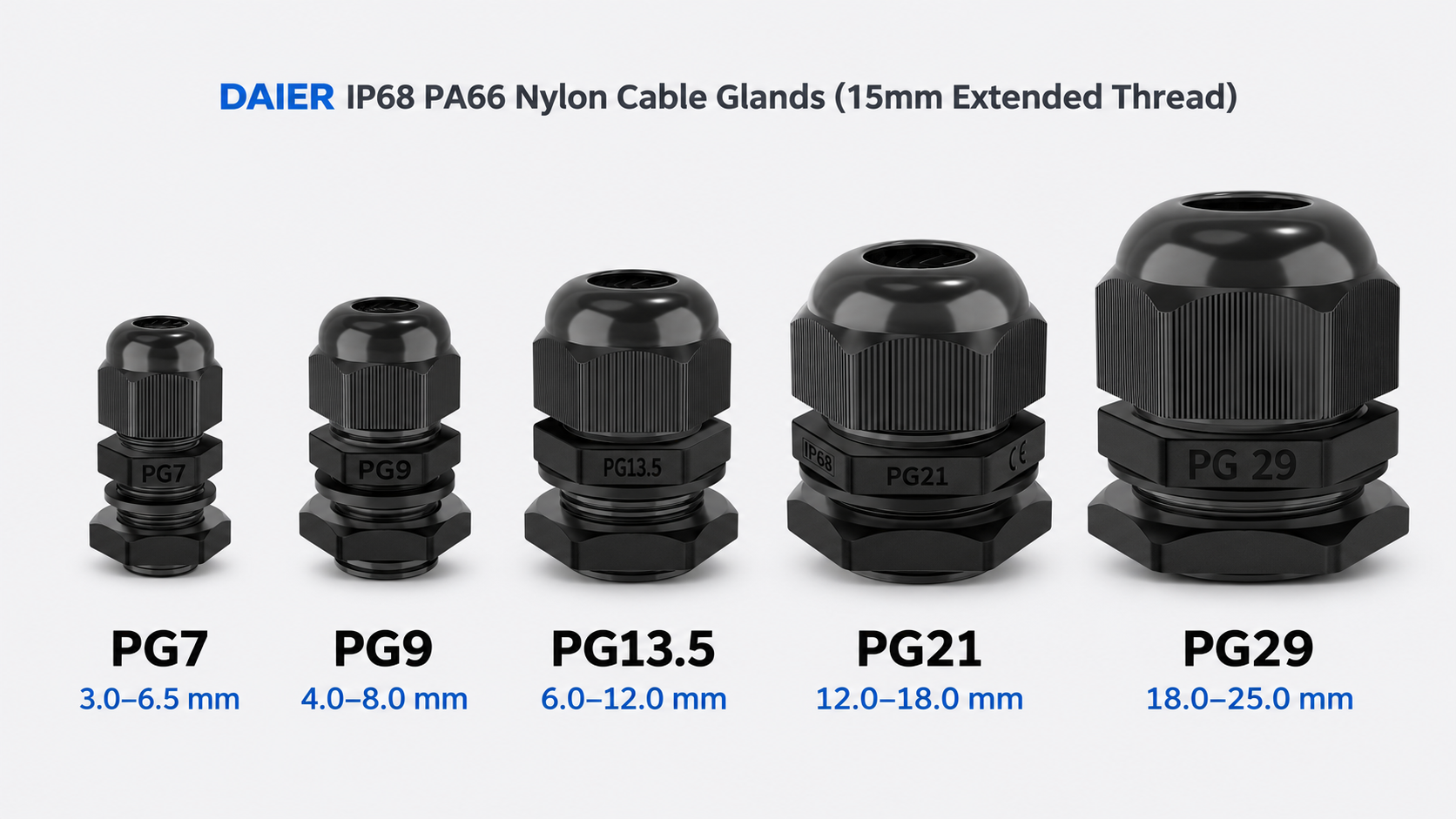
DAIER supplies PG7, PG9, PG13.5, PG21, and PG29 individually for bulk orders. The glands in this series feature black PA66 nylon bodies, 15 mm extended mounting threads, and an IP68 protection rating (complete with locknuts and rubber sealing washers). Model-specific clearance-hole dimensions appear in the mounting section below. Explore the DAIER IP68 PG cable gland series.
4. Metric Cable Gland Size Chart from M12 to M63
Metric thread designations make the nominal diameter easy to read. The M25 × 1.5 designation gives you a nominal thread diameter of 25 mm and a pitch of 1.5 mm. The hex body still needs room for a spanner, and the panel opening still needs its own specified clearance dimension.
The clamping ranges below represent typical standard nylon metric gland specifications. Because different seal designs and reducing-seal inserts vary by series, always check the exact datasheet for the part you order.
| Metric Thread | Nominal Thread OD (mm) | Typical Cable OD (mm) |
|---|---|---|
| M12 × 1.5 | 12 | 3.0–6.5 |
| M16 × 1.5 | 16 | 4.0–8.0 |
| M20 × 1.5 | 20 | 6.0–12.0 |
| M25 × 1.5 | 25 | 12.0–18.0 |
| M32 × 1.5 | 32 | 18.0–25.0 |
| M40 × 1.5 | 40 | 22.0–32.0 |
| M50 × 1.5 | 50 | 32.0–38.0 |
| M63 × 1.5 | 63 | 37.0–44.0 |
5. How to Switch from PG to Metric
Compare the Cable Fit and the Enclosure Fit
If you want to change thread systems, compare glands that cover your cable diameter first, then decide what to do about the enclosure opening. On a new panel, specify the hole size for the gland you have selected. On an existing tapped panel, keep the original thread or check whether a suitable rated thread adapter is available.
The comparison below shows functionally similar PG and metric sizes by cable range. Even when two glands clamp the exact same cable—such as PG21 (28.3 mm nominal thread OD) and M25 × 1.5 (25.0 mm nominal thread OD), both covering 12–18 mm cables—their 3.3 mm thread diameter difference means they cannot fit the same tapped enclosure port.
| Round Jacket OD | DAIER PG Option | Typical Metric Equivalent (by Cable Range) |
|---|---|---|
| 5 mm | PG9, range 4–8 mm | M16 × 1.5, typical range 4–8 mm |
| 10 mm | PG13.5, range 6–12 mm | M20 × 1.5, typical range 6–12 mm |
| 15 mm | PG21, range 12–18 mm | M25 × 1.5, typical range 12–18 mm |
| 22 mm | PG29, range 18–25 mm | M32 × 1.5, typical range 18–25 mm |
Check for NPT on Existing Equipment
Some enclosures use NPT, a tapered pipe thread covered by ASME B1.20.1. Its size is a trade designation rather than a direct millimetre diameter—for example, 1/2″ NPT measures roughly 21.3 mm across the thread OD, not 12.7 mm. Identify the thread before ordering a replacement. For an NPT-tapped entry, use a matching NPT gland or the correct rated adapter and follow the fitting maker’s sealing instructions.
6. How to Measure for a Cable Gland
Step 1: Measure the Cable Jacket
Use calipers where the seal will sit. Pick a straight section clear of connectors, bends, and moulded boots. Close the jaws lightly so you do not flatten a soft jacket. A marking such as 3 × 1.5 mm² describes the conductors—two cables with that marking can have different outside diameters.
If the jacket looks oval, take readings across both axes and ask the gland supplier whether the seal is suitable for that shape. For a flat cable, choose a gland with a seal made specifically for a flat profile.
Step 2: Identify the Enclosure Entry
For a replacement, start with the enclosure drawing, the old gland’s markings, or a thread gauge. If you only have the old gland, use calipers to check its outside diameter and a pitch gauge to check the thread. PG13.5 and M20 are just 0.4 mm apart in nominal outside diameter, so wear and part tolerance make a quick diameter reading unreliable on its own.
For an unthreaded panel opening, note both the hole diameter and panel thickness. Look inside the box as well—the locknut and tightening tool both need clearance, especially near a return flange or a crowded row of entries.
Step 3: Check the Clamping Range
A 10 mm round cable falls comfortably within DAIER’s 6–12 mm range for PG13.5, whereas it sits outside the 4–8 mm range for PG9. If you are buying for production, compare the supplier’s range with both the smallest and largest jacket diameters expected across the cable batch. If a cable sits at the extreme edge of a range, verify jacket tolerance or step up one size if needed.
7. What Is Inside a Cable Gland
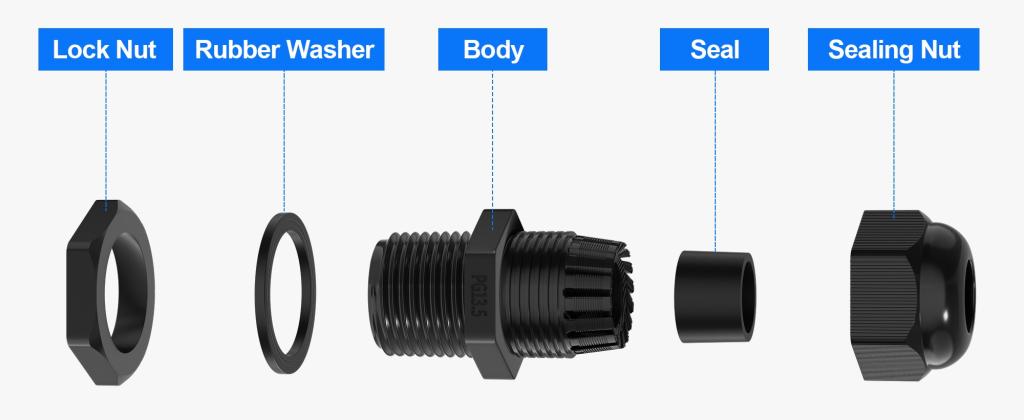
A standard straight cable gland typically has five functional parts, and each handles a different part of the installation:
| Part | What It Does |
|---|---|
| Body | Passes through or threads into the enclosure entry. The hex flange gives the installer a surface to hold or tighten. |
| Internal Seal | Closes around the cable jacket and helps determine the cable diameters the gland can accept. |
| Sealing Nut | Compresses the seal and engages the clamping fingers around the cable. |
| Rubber Washer or O-Ring | Seals the joint between the gland flange and the outer enclosure face. |
| Lock Nut | Secures the gland from the inside of an unthreaded panel opening. |
A seal insert can change the clamping range without changing the entry thread, which is why manufacturers may offer standard and reduced-range versions with the same thread. Always confirm the exact part number and clamping range before ordering.
8. Choosing Nylon, Brass, or Stainless Steel
The material choice starts with the environment around the entry. A PA66 nylon gland works reliably in both indoor control panels and outdoor waterproof junction boxes, solar enclosures, and general industrial equipment when installed with appropriate weather-resistant sealing. On heavy machinery, check mechanical loads, vibration, and operating temperature; where the enclosure sees caustic washdown, salt spray, or chemical exposure, check both the body material and seal compound against the actual conditions.
| Body Material | Where to Consider It | What to Check |
|---|---|---|
| PA66 Nylon | Control panels, outdoor junction boxes, solar boxes, and general unarmoured wiring | UV rating for direct sun, operating temperature, and compatibility with oils or chemicals |
| Nickel-Plated Brass | Machinery, heavy vibration, armoured cable, and EMI/EMC bonding | Corrosion exposure, plating integrity, mechanical rating, and cable compatibility |
| Stainless Steel | Food washdown, caustic chemical plants, and continuous marine immersion | Grade (304 vs. 316), media compatibility, seal compound, and thread lubrication |
The rubber seal deserves its own check—NBR, EPDM, and silicone offer different temperature and chemical tolerances, especially if the panel faces cleaning agents or prolonged contact with oil.
9. What an IP68 Rating Requires
Check the Immersion Conditions
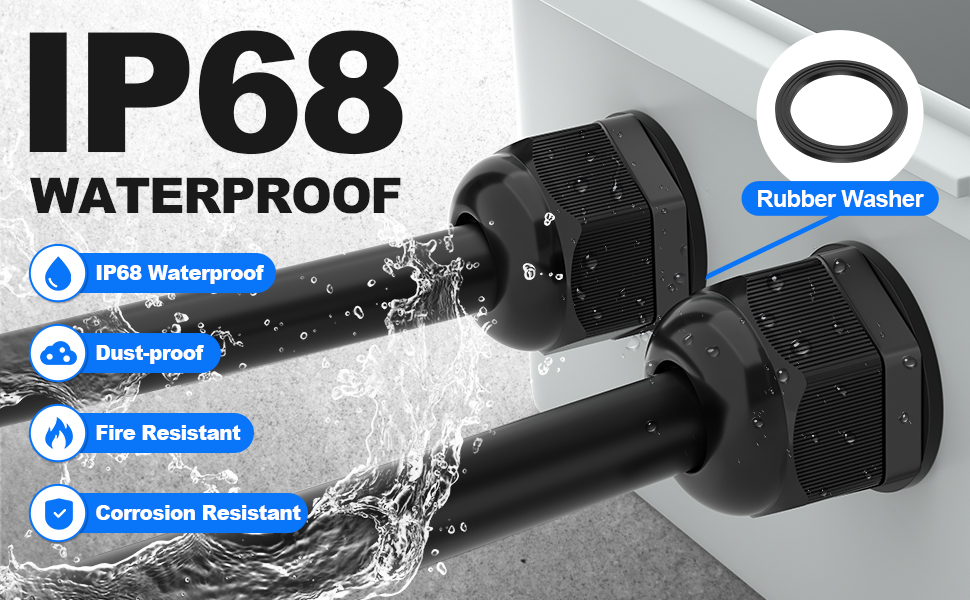
Under IEC 60529, the first digit in IP68 indicates total dust-tight protection, and the second indicates protection against continuous immersion under specified IPX8 test conditions. If the enclosure will be submerged or exposed to severe weather, confirm the test depth or pressure, immersion duration, and mounting arrangement with your supplier.
Check the Installed Assembly
At a cable entry, the internal seal closes around the cable jacket and the external rubber washer seals against the enclosure wall. Both interfaces must be assembled properly: ensure a round cable falls strictly within the model’s clamping range, verify a flat sealing face, fit the rubber washer and locknut cleanly, and tighten the sealing nut securely.
10. Cable Gland Types and Their Uses
Once the thread and cable diameter are settled, verify what the cable construction itself requires:
| Gland or Fitting Type | What It Does | Common Use |
|---|---|---|
| Standard Dome Gland | Seals and grips a round cable | Junction boxes, panels, and general wiring |
| Flat Cable Gland | Seals around a rectangular flat profile | Flat or ribbon power and control cables |
| Armoured Cable Gland | Terminates steel-wire armour with continuity | Armoured industrial power feeders |
| EMC Gland | Bonds the cable braid screen 360° | Screened VFD motor cables and instrumentation |
| Breather Fitting | Equalises pressure through a breathable membrane | Sealed outdoor boxes facing rapid temperature swings |
| Multi-Entry Gland | Routes multiple cables through one panel entry | Compact panels with limited mounting space |
11. Panel Hole Sizes and Entry Thread Length
Plain Clearance Holes and Tapped Openings
For a plain unthreaded opening, use the clearance-hole dimension from the gland’s drawing—the body passes through the opening and the locknut holds it from the inside. For a tapped opening, use the tap-drill dimensions and thread specification for that port.
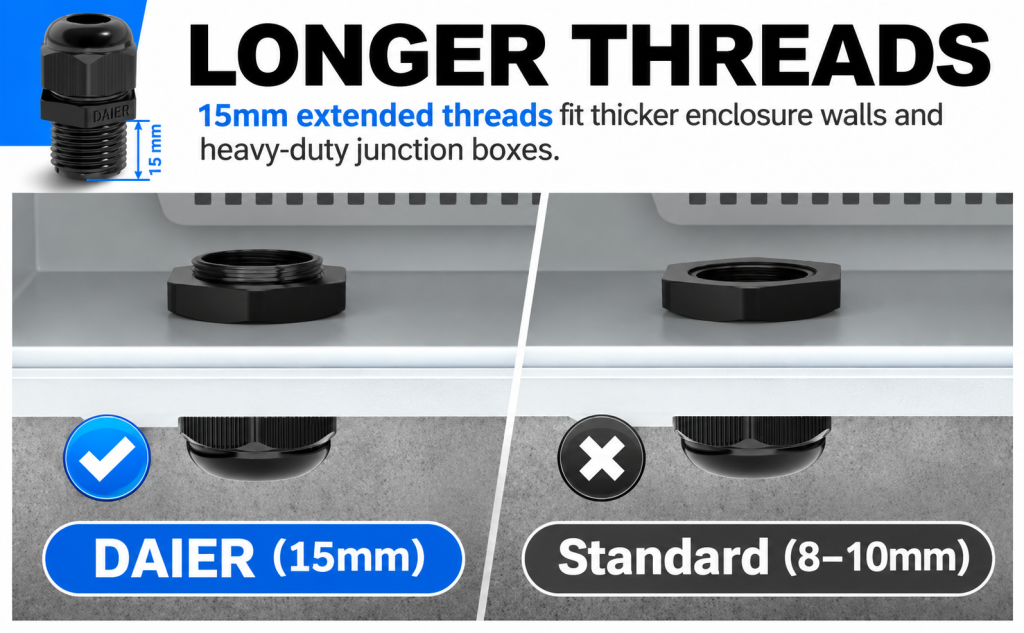
Before machining a batch, check the panel thickness, locknut access, spanner clearance, and space for the cable bend. A 15 mm extended entry thread gives the locknut full engagement on thicker waterproof junction boxes, cast housings, and double-wall cabinets where standard short threads fall short.
DAIER PG Cable Gland Mounting Dimensions
These are the model-specific mounting values for DAIER’s PA66 series. The clearance-hole ranges below apply to plain unthreaded enclosure openings; confirm tolerances before machining production panels.
| DAIER Model | Round Jacket OD (mm) | Recommended Clearance Hole (mm) | Entry Thread Length (mm) |
|---|---|---|---|
| PG7 | 3.0–6.5 | 12.5–13.0 | 15 |
| PG9 | 4.0–8.0 | 15.3–15.6 | 15 |
| PG13.5 | 6.0–12.0 | 20.4–21.0 | 15 |
| PG21 | 12.0–18.0 | 28.4–29.0 | 15 |
| PG29 | 18.0–25.0 | 37.1–37.8 | 15 |
See the full DAIER model selection and dimensions. Even when two glands share an entry thread, their thread length, washer thickness, and wrench clearance can differ—always check the exact drawing for your part number.
12. Accessories That Change the Fit
A locknut secures a gland in an unthreaded opening, while a reducer adapts a smaller gland to fit an oversized existing hole. When switching thread systems, use a rated thread adapter with matching sealing washers on both interfaces, and verify stack height and tool clearance beforehand.
Use a proper sealing washer against a flat mounting surface, and close any unused pre-drilled entries with a matching blanking plug to preserve the enclosure’s IP rating.
13. Cable Gland Ordering Checklist
Before requesting a quote or releasing a panel drawing, confirm these six details:
- Cable jacket outside diameter, tolerance, and shape (round vs. flat) at the sealing point.
- Enclosure entry type and size, including thread standard and pitch for tapped ports.
- Panel wall thickness, clearance-hole dimensions, and internal space for the locknut and spanner.
- Cable construction and any special termination needs (armour clamping, EMC shielding, or multi-cable entry).
- Required IP rating, outdoor UV exposure, and any immersion conditions.
- Body material, seal compatibility, operating temperature, and required order quantity.
14. Common Sizing Mistakes
If a drawing calls out only “20 mm,” always clarify whether it refers to the cable jacket OD, the thread major diameter, or the panel cutout. Keep each dimension on its own line in purchase specifications, and verify locknut and spanner clearance around crowded entry rows.
On replacement jobs, re-measure the new cable as well as the old fitting—a gland that gripped a thicker original jacket tightly may leak on a thinner replacement cable.
15. Frequently Asked Questions
Is PG the same as metric?
No. PG uses the DIN 40430 thread series (80° profile), while the metric sizes shown here use EN 60423 (60° profile, 1.5 mm pitch). A tapped PG13.5 port takes a PG13.5 thread, while an M20 × 1.5 port requires a matching metric thread.
What jacket diameter does a PG13.5 gland take?
DAIER’s PG13.5 gland is listed for round cable jackets from 6.0 to 12.0 mm outside diameter. Other PG13.5 models can use different seal inserts, so always verify the clamping range on the part datasheet.
Is PG13 or PG25 a standard PG size?
No. Standard DIN 40430 sizes step from PG11 to PG13.5 and PG16, and from PG21 straight to PG29. If a parts list says “PG13” or “PG25,” measure the opening first—buyers usually need PG13.5 or are confusing PG21/PG29 with Metric M25.
What size cable gland fits a 10 mm or 25 mm cable?
A 10 mm round cable sits comfortably inside DAIER’s PG13.5 (6.0–12.0 mm) or a typical M20 × 1.5 gland; check your enclosure opening to choose between them. A 25 mm jacket sits at the upper limit of PG29 (18.0–25.0 mm)—verify with calipers first, and step up to PG36 or M40 if jacket tolerances exceed 25 mm.
How do I convert a PG entry to metric?
First select a metric gland whose clamping range covers your cable, then either specify the matching metric panel hole or install a properly sealed PG-to-metric thread adapter while checking stack height and tool clearance.
Should I choose nylon or brass cable glands?
PA66 nylon suits indoor control panels, outdoor waterproof junction boxes, and general non-armoured cables where corrosion resistance and electrical insulation matter. Choose nickel-plated brass when the application calls for a metal body, heavy vibration, armoured cable termination, or EMC shielding.
Can I use a nylon cable gland outdoors?
Yes, when the selected model is rated IP68 and installed properly with its rubber sealing washer and matching round cable. Confirm UV resistance for direct sun exposure, operating temperature range, and seal compatibility with any oils or chemicals on site.
Request a Quote for IP68 PG Cable Glands
If you are sourcing glands for panel builds or enclosure assemblies, view DAIER’s IP68 PA66 Nylon Cable Glands (PG7–PG29) and request a factory quote. Choose from PG7, PG9, PG13.5, PG21, and PG29 for bulk ordering by individual size, and share your PG size, cable jacket OD, panel thickness, and target quantity for prompt OEM support.
